" transform="translate(2.266 2.266)" width="17.218780000000002px"/><path d="M 8.156 4.078 C 8.156 5.16 7.727 6.197 6.962 6.962 C 6.197 7.727 5.16 8.156 4.078 8.156 C 2.997 8.156 1.959 7.727 1.194 6.962 C 0.43 6.197 0 5.16 0 4.078 C 0 2.997 0.43 1.959 1.194 1.194 C 1.959 0.43 2.997 0 4.078 0 C 5.16 0 6.197 0.43 6.962 1.194 C 7.727 1.959 8.156 2.997 8.156 4.078 Z" fill="transparent" height="8.15622px" id="qOIptLAZR" stroke-dasharray="" stroke-linecap="butt" stroke-linejoin="miter" stroke-miterlimit="10" stroke-width="1.35938" stroke="rgb(255, 255, 255)" transform="translate(6.797 6.797)" width="8.15622px"/><path d="M 0.009 0 L 0 0" fill="transparent" height="1px" id="EJPxWJghJ" stroke-dasharray="" stroke-linecap="round" stroke-linejoin="round" stroke-width="1.8125" stroke="rgb(255, 255, 255)" transform="translate(15.857 5.891)" width="1px"/></svg>)
" transform="translate(2.719 2.719)" width="16.312450191802977px"/></svg>)
" width="17.865866856014293px"><path d="M 8.877 0 L 8.877 6.826 M 10.331 10.674 L 14.6 16 M 11.305 7.6 L 17.866 5.718 M 0 6 L 6.561 7.883" fill="transparent" height="16px" id="r6THrBoH4" stroke-dasharray="" stroke-linecap="butt" stroke-linejoin="miter" stroke-miterlimit="10" stroke-width="3.9" stroke="rgb(255, 255, 255)" width="17.865866856014293px"/><path d="M 4.947 0 L 0.976 0 C 0.717 0 0.469 0.102 0.286 0.285 C 0.103 0.468 0 0.716 0 0.975 L 0 4.945 C 0 5.484 0.437 5.92 0.976 5.92 L 4.947 5.92 C 5.485 5.92 5.921 5.484 5.921 4.945 L 5.921 0.975 C 5.921 0.436 5.485 0 4.947 0 Z" fill="rgb(255, 255, 255)" height="5.920302120642612px" id="pr91YRbal" transform="translate(5.583 6.141)" width="5.921418096841972px"/><path d="M 0 5.304 L 4.296 0" fill="transparent" height="5.303929089194531px" id="bp7qb3OHE" stroke-dasharray="" stroke-linecap="butt" stroke-linejoin="miter" stroke-miterlimit="10" stroke-width="3.9" stroke="rgb(255, 255, 255)" transform="translate(2.792 10.608)" width="4.2956242539223695px"/></g></svg>)
Black Noise Cover Feature
Black Noise Cover Feature
Black Noise Cover Feature
Aniko: In Her Element
Aniko: In Her Element

Words by Temple Egemasi
Words by Temple Egemasi
Editor In Chief: Israel Ajayi
Editor In Chief: Israel Ajayi
Photographer: Aaron Ehi-Iden,
Gideon Krama Joshua, Joseph Babalola
Photographer: Aaron Ehi-Iden,
Gideon Krama Joshua, Joseph Babalola
Creative Director: Alicia Williams-Igwonobe
Creative Director: Alicia Williams-Igwonobe
BTS Videography: Dyior Daniel
BTS Videography: Dyior Daniel
Stylist: Lois Benson-Adautin
Stylist: Lois Benson-Adautin
Managing Editor: Olawale Toriola
Managing Editor: Olawale Toriola
Head Of Content: Stephanie Oyinki
Head Of Content: Stephanie Oyinki
Head of Digital: Biyi Campbell
Head of Digital: Biyi Campbell
Digital Design Director: Kiko Ononye
Digital Design Director: Kiko Ononye
Production Company: D10
Production Company: D10
Executive Producer: Theresa Ajayi
Executive Producer: Theresa Ajayi
Production Coordinator: Jay Ibeh
Production Coordinator: Jay Ibeh
Production assistant: Ebun Ajina
Production assistant: Ebun Ajina
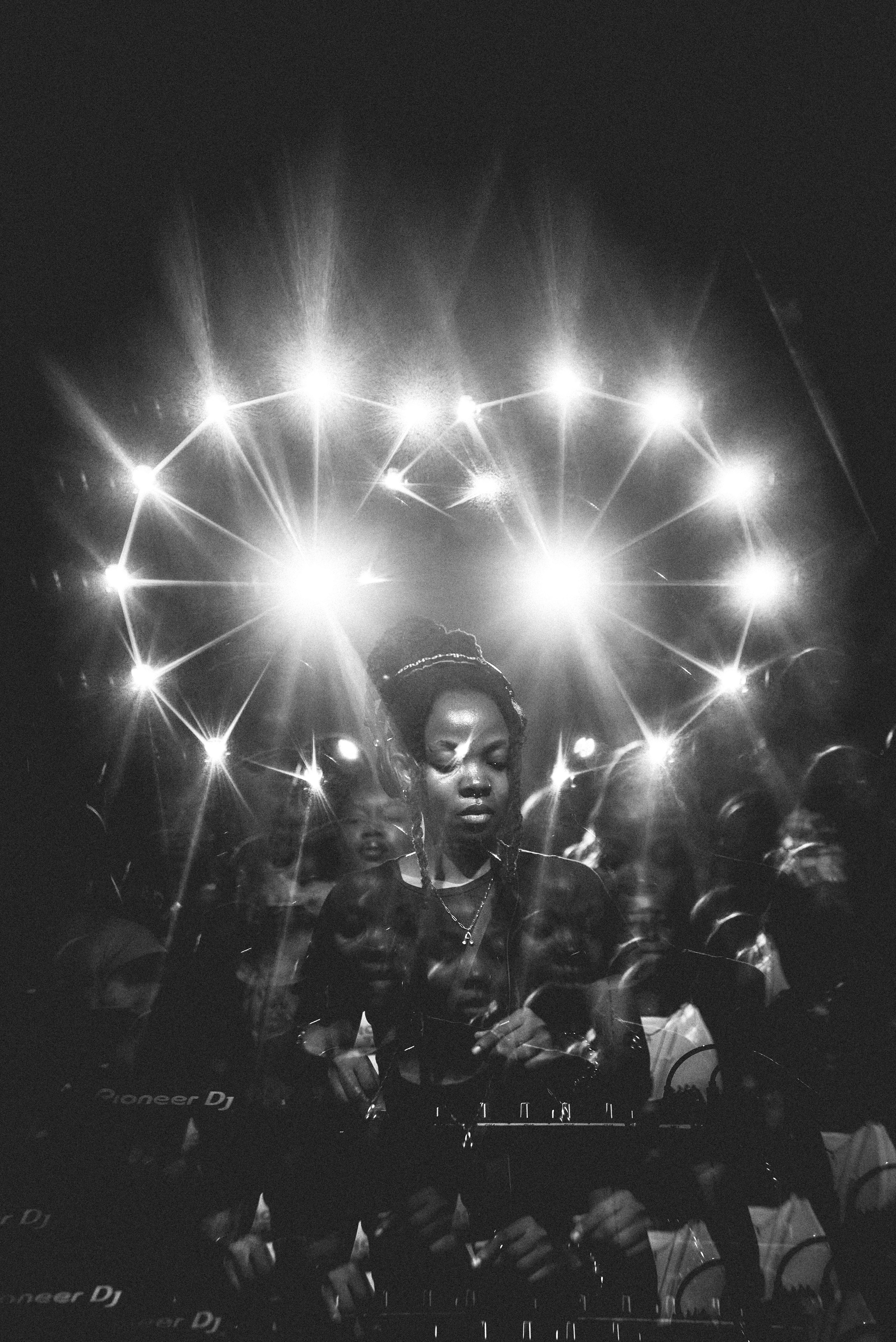
If you have ever seen an Aniko set, you’ll agree that she plays with the unhurried certainty of someone who has decided how the night ends. She doesn't feel the need to perform a persona, and she doesn’t attempt to signal through theatre. She just begins, and the room folds into whatever she’s feeling.
That quality, that unreadable composure people have spent the better part of three years trying to decode as mystique or calculation, turns out to be something far more specific. She says, matter-of-factly, that she spent a lot of her childhood learning people. She lives with Attention Deficit Hyperactivity Disorder, and most of what reads as cool on the outside is, in her words, really just manifesting in neurodivergence. She is constantly feeling, while flipping through countless folders of properly archived neurotypical responses, trying to give an appropriate one. And, she always pauses because she is finding the most accurate way to say what she means.
"I spent a lot of my childhood years trying to learn people because I was, or I still am, very autistic. So, most of what people think is cool is really just autism manifesting. I experience life in a way where I'm not expressive with emotions and things don't get to me, even bad things, even sad things."
There is a pervasive temptation in the media to paint "Aniko" as a constructed, larger-than-life alter ego, a protective armour that she steps into when she approaches the CDJs to command the sprawling crowds of Group Therapy. She dismantles this with a refreshing candour, insisting that the persona is simply the truest, most unfiltered manifestation of a mind that processes the world through a neurodivergent lens. Aniko describes an existence defined by quiet observation, noting that even profound personal tragedies were met with the same outward expression as the mundane events of daily life.
Aniko embodies a radical stoicism that has become a defining signature of her meteoric rise from a bedroom DJ playing high school events to the undisputed pillar of Nigeria's contemporary electronic renaissance. This explains a lot about how Aniko has built what she has built; not through performed passion, but through a method of observation that processes and acts on the data.
If you have ever seen an Aniko set, you’ll agree that she plays with the unhurried certainty of someone who has decided how the night ends. She doesn't feel the need to perform a persona, and she doesn’t attempt to signal through theatre. She just begins, and the room folds into whatever she’s feeling.
That quality, that unreadable composure people have spent the better part of three years trying to decode as mystique or calculation, turns out to be something far more specific. She says, matter-of-factly, that she spent a lot of her childhood learning people. She lives with Attention Deficit Hyperactivity Disorder, and most of what reads as cool on the outside is, in her words, really just manifesting in neurodivergence. She is constantly feeling, while flipping through countless folders of properly archived neurotypical responses, trying to give an appropriate one. And, she always pauses because she is finding the most accurate way to say what she means.
"I spent a lot of my childhood years trying to learn people because I was, or I still am, very autistic. So, most of what people think is cool is really just autism manifesting. I experience life in a way where I'm not expressive with emotions and things don't get to me, even bad things, even sad things."
There is a pervasive temptation in the media to paint "Aniko" as a constructed, larger-than-life alter ego, a protective armour that she steps into when she approaches the CDJs to command the sprawling crowds of Group Therapy. She dismantles this with a refreshing candour, insisting that the persona is simply the truest, most unfiltered manifestation of a mind that processes the world through a neurodivergent lens. Aniko describes an existence defined by quiet observation, noting that even profound personal tragedies were met with the same outward expression as the mundane events of daily life.
Aniko embodies a radical stoicism that has become a defining signature of her meteoric rise from a bedroom DJ playing high school events to the undisputed pillar of Nigeria's contemporary electronic renaissance. This explains a lot about how Aniko has built what she has built; not through performed passion, but through a method of observation that processes and acts on the data.

Say You Want It.
Say You Want It.
“Aniko” was coined with similar meticulousness. Born Aderinsola Ogala, she adopted her moniker by replacing the last letter of her oriki, “Àníkẹ́”, a move she admitted was intentional, as she wanted a single, simple, catchy word.
Aniko grew up in a household where music was just the air. Her brothers, Damayo and Oyin (Michael OG), were producers and DJs, which meant that controllers, mixers, and other Digital Audio Workstations were simply objects available to the curious. She admits that she did not sit down to formally learn DJing. She picked it up the way you pick up a language when everyone around you speaks it, through proximity and repetition and a lot of unsupervised time with equipment that wasn't hers. The genre she landed in wasn't an accident either. House music drew her precisely because it is a genre without a passport. Unlike Afrobeats, which has its roots firmly planted in Nigeria, or hip-hop, whose industry infrastructure is in the US, house music does not require you to establish geographic credentials. “There is an audience for it everywhere,” infrastructure for it everywhere, and no single country holds its deed. That borderlessness felt like freedom to her. Still does.
"House music is a genre for DJs and producers. It's not for singers... It's a freeing genre. It's a genre without borders, you know? You don't have to talk about, 'Oh, is there a market here?' There's a market for house music everywhere."
The moment it all clicked into something real came at a prom night at Babington Macaulay Junior Seminary. The party needed someone who could play music and mix properly, and the ensuing conversation was,
“You can play, but can you mix?”
“Yeah, I can.”
“Okay then.”
Aniko has no clear explanation for how she was able to hold her own in front of her teenage peers, as in her own words, “I just wasn't seeing them.” She, however, recollects the technique she employed in mesmerizing them from the decks that night: "I assess and tap into what people around me are feeling, and that guides me into how I feel and from there the music flows.” She stepped in, it worked, and she walked away with a new piece of self-knowledge: she could DJ. That was the beginning of a capability confirmed by a prom crowd that didn't reckon they were witnessing the start of anything.
After secondary school, she entered the professional world as a data analyst. The two lives, the office and the booth, ran in deliberate parallel for years. Her co-workers knew she was a DJ and sometimes ribbed her about it with the mild condescension that creative people in office environments receive on a reliable schedule. She absorbed it without particular feeling, describing the two as entirely separate worlds. She didn't need the office to understand what she was doing with music, and she didn't need the music to complicate what she was doing in the office. Both were hers. Neither bled into the other.
What cracked the two worlds open was COVID. Lockdown arrived right as she had started to take bookings and she'd done one event before everywhere shut down, and suddenly there were no shows, no rooms, no feedback loops of any kind. What there was was time. She started posting videos online, drilling her craft in a vacuum, and watching videos too. During those months, her references included Switch, Cuppy, and DJ Consequence, whose careers she tracked with the intensity of someone building a syllabus, studying not just how they played but where they played and the rooms they occupied. The fact that the room she would eventually build became a space defined partly by its visibility for women and queer communities is not disconnected from who she was studying when no one was watching.
By the time the world opened again, she was ready to be in front of people properly. She had a genre that was hers, a name she'd constructed from her own oriki, and two years of solitary practice behind her. What she didn't have yet was a room.
“Aniko” was coined with similar meticulousness. Born Aderinsola Ogala, she adopted her moniker by replacing the last letter of her oriki, “Àníkẹ́”, a move she admitted was intentional, as she wanted a single, simple, catchy word.
Aniko grew up in a household where music was just the air. Her brothers, Damayo and Oyin (Michael OG), were producers and DJs, which meant that controllers, mixers, and other Digital Audio Workstations were simply objects available to the curious. She admits that she did not sit down to formally learn DJing. She picked it up the way you pick up a language when everyone around you speaks it, through proximity and repetition and a lot of unsupervised time with equipment that wasn't hers. The genre she landed in wasn't an accident either. House music drew her precisely because it is a genre without a passport. Unlike Afrobeats, which has its roots firmly planted in Nigeria, or hip-hop, whose industry infrastructure is in the US, house music does not require you to establish geographic credentials. “There is an audience for it everywhere,” infrastructure for it everywhere, and no single country holds its deed. That borderlessness felt like freedom to her. Still does.
"House music is a genre for DJs and producers. It's not for singers... It's a freeing genre. It's a genre without borders, you know? You don't have to talk about, 'Oh, is there a market here?' There's a market for house music everywhere."
The moment it all clicked into something real came at a prom night at Babington Macaulay Junior Seminary. The party needed someone who could play music and mix properly, and the ensuing conversation was,
“You can play, but can you mix?”
“Yeah, I can.”
“Okay then.”
Aniko has no clear explanation for how she was able to hold her own in front of her teenage peers, as in her own words, “I just wasn't seeing them.” She, however, recollects the technique she employed in mesmerizing them from the decks that night: "I assess and tap into what people around me are feeling, and that guides me into how I feel and from there the music flows.” She stepped in, it worked, and she walked away with a new piece of self-knowledge: she could DJ. That was the beginning of a capability confirmed by a prom crowd that didn't reckon they were witnessing the start of anything.
After secondary school, she entered the professional world as a data analyst. The two lives, the office and the booth, ran in deliberate parallel for years. Her co-workers knew she was a DJ and sometimes ribbed her about it with the mild condescension that creative people in office environments receive on a reliable schedule. She absorbed it without particular feeling, describing the two as entirely separate worlds. She didn't need the office to understand what she was doing with music, and she didn't need the music to complicate what she was doing in the office. Both were hers. Neither bled into the other.
What cracked the two worlds open was COVID. Lockdown arrived right as she had started to take bookings and she'd done one event before everywhere shut down, and suddenly there were no shows, no rooms, no feedback loops of any kind. What there was was time. She started posting videos online, drilling her craft in a vacuum, and watching videos too. During those months, her references included Switch, Cuppy, and DJ Consequence, whose careers she tracked with the intensity of someone building a syllabus, studying not just how they played but where they played and the rooms they occupied. The fact that the room she would eventually build became a space defined partly by its visibility for women and queer communities is not disconnected from who she was studying when no one was watching.
By the time the world opened again, she was ready to be in front of people properly. She had a genre that was hers, a name she'd constructed from her own oriki, and two years of solitary practice behind her. What she didn't have yet was a room.

Aniko wears Montone
Aniko wears Montone

Aniko wears Montone
Aniko wears Montone
Facing The Music.
Facing The Music.
Group Therapy launched in the summer of 2023. By Aniko's account, the first edition was a guinea pig. If it didn't work, there was no guaranteed sequel. What decided otherwise was the overwhelming turnout and subsequent positive feedback. Someone who'd been there, equal parts shocked and converted, posted their disbelief to the internet via TikTok, and the video went viral. Aniko looked at it and understood that she was now in a commitment. An event that goes viral on its first night, before it has a track record or a brand, is not a project. It is something else.
The name had been chosen while on a phone call, out of a need to give the concept a home. Group Therapy: the idea that a room full of people, together, could be the medicine. The Group Therapy framing was not incidental, seeing that from the beginning, the crowd that showed up was not the result of a demographic calculation. It was simply Aniko's people, and most of Aniko's people happen to be queer. Aniko describes the event's inclusivity not as a design choice but instead labels it as an intrinsic nature. In her words, "It's not something to ‘hold close to’ when it is your life." The face of the event has always been her face, and her face has not changed as the rooms got bigger. What changed was the scale. And with scale came a specific set of pressures that a TikTok thumbnail will never show you.
For starters, Lagos does not have a healthy stock of properly equipped venues. This is not a minor logistical inconvenience; it is the foundational structural problem of running a serious electronic music event in this city. Almost every Group Therapy requires dry-hiring the full infrastructure kit, sound, decks, ventilation, stage design, assembled from scratch each time. There is no turnkey, and no venue comes ready. There is only the very lean team, rebuilding the room before every edition. Then there is the venue politics. At a recent event at Landmark, some officers showed up at midnight and spent close to an hour threatening to shut things down over a claimed overcrowding violation. Aniko walked the venue with them personally, showed them the floor space, and absorbed the friction until it resolved. Even though she recounts it with the flatness of someone who has filed this particular experience under routine, we cannot ignore that it was a negotiation that consumed nearly two hours of an event she was also supposed to be running and playing at. Adding to the venue brouhaha is the bizarre recurring expense of replacing a toilet at a venue, mid-event or post-event, which is now normal enough that she describes it with barely a pause. She cannot explain why it keeps happening. It just does.
It would be easy to frame all of this as the chaos that creative people heroically absorb. The more accurate frame is that Aniko manages it through the same instincts she developed as a data analyst living with ADHD. She describes the crossover as something instinctive: when she looks at a spreadsheet or a budget, she is simply reading patterns. How people spend, how they party, and what questions they ask themselves before buying a ticket. She brought the pattern recognition into a context where it proved considerably more useful.
That instinct is also what has kept the community from being priced out of its own event. As Group Therapy grew, so did the secondary market pressure, i.e. the resale dynamics that tend to follow any event that becomes a cultural destination. Managing that, keeping the right people in the room, comes down to the same principle: understand the behaviour, then design against the bad version of it. It is not glamorous, and it is sometimes thankless but we agree that it is the difference between an event that feels like a community and one that only calls itself one.
Group Therapy launched in the summer of 2023. By Aniko's account, the first edition was a guinea pig. If it didn't work, there was no guaranteed sequel. What decided otherwise was the overwhelming turnout and subsequent positive feedback. Someone who'd been there, equal parts shocked and converted, posted their disbelief to the internet via TikTok, and the video went viral. Aniko looked at it and understood that she was now in a commitment. An event that goes viral on its first night, before it has a track record or a brand, is not a project. It is something else.
The name had been chosen while on a phone call, out of a need to give the concept a home. Group Therapy: the idea that a room full of people, together, could be the medicine. The Group Therapy framing was not incidental, seeing that from the beginning, the crowd that showed up was not the result of a demographic calculation. It was simply Aniko's people, and most of Aniko's people happen to be queer. Aniko describes the event's inclusivity not as a design choice but instead labels it as an intrinsic nature. In her words, "It's not something to ‘hold close to’ when it is your life." The face of the event has always been her face, and her face has not changed as the rooms got bigger. What changed was the scale. And with scale came a specific set of pressures that a TikTok thumbnail will never show you.
For starters, Lagos does not have a healthy stock of properly equipped venues. This is not a minor logistical inconvenience; it is the foundational structural problem of running a serious electronic music event in this city. Almost every Group Therapy requires dry-hiring the full infrastructure kit, sound, decks, ventilation, stage design, assembled from scratch each time. There is no turnkey, and no venue comes ready. There is only the very lean team, rebuilding the room before every edition. Then there is the venue politics. At a recent event at Landmark, some officers showed up at midnight and spent close to an hour threatening to shut things down over a claimed overcrowding violation. Aniko walked the venue with them personally, showed them the floor space, and absorbed the friction until it resolved. Even though she recounts it with the flatness of someone who has filed this particular experience under routine, we cannot ignore that it was a negotiation that consumed nearly two hours of an event she was also supposed to be running and playing at. Adding to the venue brouhaha is the bizarre recurring expense of replacing a toilet at a venue, mid-event or post-event, which is now normal enough that she describes it with barely a pause. She cannot explain why it keeps happening. It just does.
It would be easy to frame all of this as the chaos that creative people heroically absorb. The more accurate frame is that Aniko manages it through the same instincts she developed as a data analyst living with ADHD. She describes the crossover as something instinctive: when she looks at a spreadsheet or a budget, she is simply reading patterns. How people spend, how they party, and what questions they ask themselves before buying a ticket. She brought the pattern recognition into a context where it proved considerably more useful.
That instinct is also what has kept the community from being priced out of its own event. As Group Therapy grew, so did the secondary market pressure, i.e. the resale dynamics that tend to follow any event that becomes a cultural destination. Managing that, keeping the right people in the room, comes down to the same principle: understand the behaviour, then design against the bad version of it. It is not glamorous, and it is sometimes thankless but we agree that it is the difference between an event that feels like a community and one that only calls itself one.

Aniko wears Meji Meji top, WWYPD Pants & Adidas Sambas
Aniko wears Meji Meji top, WWYPD Pants & Adidas Sambas

Aniko wears Meji Meji top, WWYPD Pants & Adidas Sambas
Aniko wears Meji Meji top, WWYPD Pants & Adidas Sambas

Aniko wears Meji Meji top, WWYPD Pants & Adidas Sambas
Aniko wears Meji Meji top, WWYPD Pants & Adidas Sambas
Even in Canada, Ota wa.
Even in Canada, Ota wa.
None of this has happened in a scene that was waiting ready-made for her. The EDM scene is characteristically progressive with a general leaning towards egalitarian values, but some electronic music communities, especially in markets where the genre is still consolidating, have a specific way of reminding women that the default assumption is incompetence; technical underestimation, social policing, the low-grade surveillance of whether she carries herself with the correct ratio of skill to softness. Aniko named all of this for herself before she started. She told herself, from the very beginning, that she would experience things she did not want to experience because she is a woman, and that people would hold her to standards they would not apply to men in the same space. Having made that reckoning in advance, she was not blindsided when it arrived.
Her response to it is characteristically her own. She is very good, she says, at blocking out noise and listening to herself. But blocking out is only half of it. The other half is fuel. She understands that being born into the patriarchy means having to wrestle with misogyny, which she asserts is easier for her because she embraces it and looks forward to shushing it every chance she gets.
“I remind myself that even the greater I become, I’m still a woman, and there will be men who are upset by it…and that really fuels me. It fuels me even more knowing that whenever I’m surrounded by men, I just want to do better. I want to be better than you.”
While we are in between looks during the shoot, Aniko also stresses that sitting squarely on the spectrum is a double-edged sword, as she has to struggle with object impermanence all her life. She admits that she has had to be a bit more careful with interpersonal relationships and that she understands the decisions people may have reached as a result. When asked how she feels about it, her response is simple, “I understand that they may never understand.”
Her general refusal to conform to the expectations of the traditional mainstream has inherently shaped the demographic reality of Group Therapy, which organically blossomed from a small, intimate gathering of her immediate social circle into a massive, sprawling sanctuary for the marginalized in Lagos who are perpetually starved for safe spaces that do not require them to conform to the norm or dilute their identities.
The scene that doubted her is now, by any measure, the scene that she is officially part of the definition of. "GT" in the vocabulary of a certain generation in Lagos maps to Group Therapy before it maps to any bank. That migration of meaning happened through consistency, through the bi-monthly rhythm that gave both DJs and audiences room to grow, and through a founder who treated every edition as infrastructure for the next one.
None of this has happened in a scene that was waiting ready-made for her. The EDM scene is characteristically progressive with a general leaning towards egalitarian values, but some electronic music communities, especially in markets where the genre is still consolidating, have a specific way of reminding women that the default assumption is incompetence; technical underestimation, social policing, the low-grade surveillance of whether she carries herself with the correct ratio of skill to softness. Aniko named all of this for herself before she started. She told herself, from the very beginning, that she would experience things she did not want to experience because she is a woman, and that people would hold her to standards they would not apply to men in the same space. Having made that reckoning in advance, she was not blindsided when it arrived.
Her response to it is characteristically her own. She is very good, she says, at blocking out noise and listening to herself. But blocking out is only half of it. The other half is fuel. She understands that being born into the patriarchy means having to wrestle with misogyny, which she asserts is easier for her because she embraces it and looks forward to shushing it every chance she gets.
“I remind myself that even the greater I become, I’m still a woman, and there will be men who are upset by it…and that really fuels me. It fuels me even more knowing that whenever I’m surrounded by men, I just want to do better. I want to be better than you.”
While we are in between looks during the shoot, Aniko also stresses that sitting squarely on the spectrum is a double-edged sword, as she has to struggle with object impermanence all her life. She admits that she has had to be a bit more careful with interpersonal relationships and that she understands the decisions people may have reached as a result. When asked how she feels about it, her response is simple, “I understand that they may never understand.”
Her general refusal to conform to the expectations of the traditional mainstream has inherently shaped the demographic reality of Group Therapy, which organically blossomed from a small, intimate gathering of her immediate social circle into a massive, sprawling sanctuary for the marginalized in Lagos who are perpetually starved for safe spaces that do not require them to conform to the norm or dilute their identities.
The scene that doubted her is now, by any measure, the scene that she is officially part of the definition of. "GT" in the vocabulary of a certain generation in Lagos maps to Group Therapy before it maps to any bank. That migration of meaning happened through consistency, through the bi-monthly rhythm that gave both DJs and audiences room to grow, and through a founder who treated every edition as infrastructure for the next one.

Aniko wears Montone top, BONFO Shorts, Bola PSD Socks & Doc Martens Loafers
Aniko wears Montone top, BONFO Shorts, Bola PSD Socks & Doc Martens Loafers

Aniko wears Montone top, BONFO Shorts, Bola PSD Socks & Doc Martens Loafers
Aniko wears Montone top, BONFO Shorts, Bola PSD Socks & Doc Martens Loafers
Doings Etc.
Doings Etc.
14A Labs is the formal name for something that had already been running for two and a half years before it had a name. It is Aniko's co-founded creative agency one-part event management, one-part aimed at developing Nigerian house DJs for international careers by providing them with the infrastructure to move outward. Weareallchemical’s Rwanda booking happened under 14A before there was a company name attached to the work. There have been many more since then. The roster now sits at three, with one more being finalized. With the current roster being only women, she is quick to note that the skew is a matter of priority, not exclusion. Women are underrepresented. That is simply the starting point.
The newest addition is Earthsurfing, who holds a dual position as a Group Therapy resident and a 14A talent. That duality captures exactly what Group Therapy has become beyond its party identity: a formidable launchpad. 14A handles the layer that requires structure, like the international billings, the conversations with festivals, and the bookings that benefit from having someone between the artist and the ask.
Sidequests arrived this year as Group Therapy's most visible experiment. It is best described as a sub-series that deliberately exits Afrohouse and opens into broader electronic territory. And even though Aniko claims she’s not one for actual sidequests, Sidequests points out that she is willing to do a little extra, a little differently. Aniko’s decision to close GT XIII with a tech house set was a result of said calculated variance, a read of what the room would have already received. She reasoned that “with Heavy-K, J Gadget, and Weareallchemicals all playing earlier in the evening, the Afrohouse quota for the night had been more than filled.” The room was already safe, so she went somewhere else. She knew the room was safe for something different because she had already measured what the room had consumed. The experiment worked, and more than that, it opened a new creative aperture for her. Even though it is one she is not yet ready to fully describe, when the next iteration lands, we will know.
"Heavy plays, J Gadget plays, Blessing plays, those three DJs in that sequence have already given you what you need to hear in terms of Afro House… the quota has already been filled. I'm trying to do something else."
14A Labs is the formal name for something that had already been running for two and a half years before it had a name. It is Aniko's co-founded creative agency one-part event management, one-part aimed at developing Nigerian house DJs for international careers by providing them with the infrastructure to move outward. Weareallchemical’s Rwanda booking happened under 14A before there was a company name attached to the work. There have been many more since then. The roster now sits at three, with one more being finalized. With the current roster being only women, she is quick to note that the skew is a matter of priority, not exclusion. Women are underrepresented. That is simply the starting point.
The newest addition is Earthsurfing, who holds a dual position as a Group Therapy resident and a 14A talent. That duality captures exactly what Group Therapy has become beyond its party identity: a formidable launchpad. 14A handles the layer that requires structure, like the international billings, the conversations with festivals, and the bookings that benefit from having someone between the artist and the ask.
Sidequests arrived this year as Group Therapy's most visible experiment. It is best described as a sub-series that deliberately exits Afrohouse and opens into broader electronic territory. And even though Aniko claims she’s not one for actual sidequests, Sidequests points out that she is willing to do a little extra, a little differently. Aniko’s decision to close GT XIII with a tech house set was a result of said calculated variance, a read of what the room would have already received. She reasoned that “with Heavy-K, J Gadget, and Weareallchemicals all playing earlier in the evening, the Afrohouse quota for the night had been more than filled.” The room was already safe, so she went somewhere else. She knew the room was safe for something different because she had already measured what the room had consumed. The experiment worked, and more than that, it opened a new creative aperture for her. Even though it is one she is not yet ready to fully describe, when the next iteration lands, we will know.
"Heavy plays, J Gadget plays, Blessing plays, those three DJs in that sequence have already given you what you need to hear in terms of Afro House… the quota has already been filled. I'm trying to do something else."

Aniko wears Montone top, BONFO Shorts, Bola PSD Socks & Doc Martens Loafers
Aniko wears Montone top, BONFO Shorts, Bola PSD Socks & Doc Martens Loafers

Aniko wears Montone top, BONFO Shorts, Bola PSD Socks & Doc Martens Loafers
Aniko wears Montone top, BONFO Shorts, Bola PSD Socks & Doc Martens Loafers

Aniko wears Montone top, BONFO Shorts, Bola PSD Socks & Doc Martens Loafers
Aniko wears Montone top, BONFO Shorts, Bola PSD Socks & Doc Martens Loafers
Clutch
Clutch
Aniko recently played at Afronation, and then in in Ibiza, and immediately followed up with an Amsterdam installation of Klub Aniko, and she is honest about the mixture of feelings involved. The gratitude is real; sometimes she looks at her life and genuinely cannot believe it is hers. But gratitude, for her, has a ceiling, and she does not sit inside it. "You can't be happy for crumbs. You have to strive for more. I am happy I have Ibiza bookings, maybe an Ibiza residency would be nice too, you know?" There will be a next thing. The target keeps creeping north because she keeps moving it herself. While easily bored, Aniko asserts that she is very, very ambitious. For Aniko, the attainment of a massive milestone is never viewed as an endpoint, but merely as the newly established baseline from which she must launch her next, even more impudent offensive.
Excess is her character, and she embodies this in every aspect of her career. A perfect example of this is the massive growth of Group Therapy under her curation. What began as a small event in an Ikate hall has exploded into an international phenomenon. Group Therapy now hosts massive events in major global hubs like London, Amsterdam, Nairobi, Accra, and Abuja. Along the way, the event's expansion has prioritized human connection over corporate machinery, relying heavily on a network of dedicated industry peers and community organizers to translate the sweat of the rave across borders rather than leaning on traditional platform partnerships. Aniko’s talent lineup curation is just as ambitious. She consistently books top-tier Afrohouse talent, including international acts like Nitefreak, Desiree, Funky QLA, Jazzwrld, and Thukuthela. She even pulled off the rare feat of booking South African hitmaker Dlala Thukzin twice. Reiterating her dominance in the space, Aniko has managed to bring all three pioneers who publicly claim ownership of the "3-Step" sound, Prince Kaybee, Thakzin, and Heavy-K, to the Group Therapy stage.
Group Therapy celebrated its third anniversary on the 25th of August, and it was the embodiment of Group Therapy’s “why?”
When the legacy question comes, she nearly sidesteps it. She insists that she does not want to sound cocky, then she makes the point anyway, in the most efficient way:
"You know how people think about Afrobeats, and they're like Fela. Yeah. I'll just leave it there like back home, you know?"
Of course, she is not comparing herself to Afrobeats. She is pointing at the category of permanence she intends to occupy within this genre, this era, this scene. Not a footnote. Not an influence with an asterisk. Just: when you think of this moment in Nigerian electronic music, you know.
The conversation winds down the way Aniko would probably end a set. A natural, silent convergence caused by a dearth of topics. Her idea of a perfect day is being at home, unbothered, or even better, an early day at Tarkwa Bay with the sun and some music. Waking up early and moving through the hours without agenda. Before she jets off yet again to London for her Piano People set, Aniko is currently grounded in Lagos and working on original music. When I pressed about when we should be expecting her first official release, she just asked me to relax. It never seems that deep for her, yet somehow, everything she’s touched seems to be.
The conversation winds down the way Aniko would probably end a set. A natural, silent convergence caused by a dearth of topics. Her idea of a perfect day is being at home, unbothered, or even better, an early day at Tarkwa Bay with the sun and some music. Waking up early and moving through the hours without an agenda. She’s left yet again to London for her Piano People set, but before that Aniko currently grounded in Lagos and working on original music. When I pressed about when we should be expecting her first official release, she just asked me to relax. It never seems that deep for her, yet somehow, everything she’s touched seems to be.
Aniko recently played at Afronation, and then in in Ibiza, and immediately followed up with an Amsterdam installation of Klub Aniko, and she is honest about the mixture of feelings involved. The gratitude is real; sometimes she looks at her life and genuinely cannot believe it is hers. But gratitude, for her, has a ceiling, and she does not sit inside it. "You can't be happy for crumbs. You have to strive for more. I am happy I have Ibiza bookings, maybe an Ibiza residency would be nice too, you know?" There will be a next thing. The target keeps creeping north because she keeps moving it herself. While easily bored, Aniko asserts that she is very, very ambitious. For Aniko, the attainment of a massive milestone is never viewed as an endpoint, but merely as the newly established baseline from which she must launch her next, even more impudent offensive.
Excess is her character, and she embodies this in every aspect of her career. A perfect example of this is the massive growth of Group Therapy under her curation. What began as a small event in an Ikate hall has exploded into an international phenomenon. Group Therapy now hosts massive events in major global hubs like London, Amsterdam, Nairobi, Accra, and Abuja. Along the way, the event's expansion has prioritized human connection over corporate machinery, relying heavily on a network of dedicated industry peers and community organizers to translate the sweat of the rave across borders rather than leaning on traditional platform partnerships. Aniko’s talent lineup curation is just as ambitious. She consistently books top-tier Afrohouse talent, including international acts like Nitefreak, Desiree, Funky QLA, Jazzwrld, and Thukuthela. She even pulled off the rare feat of booking South African hitmaker Dlala Thukzin twice. Reiterating her dominance in the space, Aniko has managed to bring all three pioneers who publicly claim ownership of the "3-Step" sound, Prince Kaybee, Thakzin, and Heavy-K, to the Group Therapy stage.
Group Therapy celebrated its third anniversary on the 25th of August, and it was the embodiment of Group Therapy’s “why?”
When the legacy question comes, she nearly sidesteps it. She insists that she does not want to sound cocky, then she makes the point anyway, in the most efficient way:
"You know how people think about Afrobeats, and they're like Fela. Yeah. I'll just leave it there like back home, you know?"
Of course, she is not comparing herself to Afrobeats. She is pointing at the category of permanence she intends to occupy within this genre, this era, this scene. Not a footnote. Not an influence with an asterisk. Just: when you think of this moment in Nigerian electronic music, you know.
The conversation winds down the way Aniko would probably end a set. A natural, silent convergence caused by a dearth of topics. Her idea of a perfect day is being at home, unbothered, or even better, an early day at Tarkwa Bay with the sun and some music. Waking up early and moving through the hours without agenda. Before she jets off yet again to London for her Piano People set, Aniko is currently grounded in Lagos and working on original music. When I pressed about when we should be expecting her first official release, she just asked me to relax. It never seems that deep for her, yet somehow, everything she’s touched seems to be.
The conversation winds down the way Aniko would probably end a set. A natural, silent convergence caused by a dearth of topics. Her idea of a perfect day is being at home, unbothered, or even better, an early day at Tarkwa Bay with the sun and some music. Waking up early and moving through the hours without an agenda. She’s left yet again to London for her Piano People set, but before that Aniko currently grounded in Lagos and working on original music. When I pressed about when we should be expecting her first official release, she just asked me to relax. It never seems that deep for her, yet somehow, everything she’s touched seems to be.


Black Noise Mag
Black Noise Mag

Black Noise Mag