" transform="translate(2.266 2.266)" width="17.218780000000002px"/><path d="M 8.156 4.078 C 8.156 5.16 7.727 6.197 6.962 6.962 C 6.197 7.727 5.16 8.156 4.078 8.156 C 2.997 8.156 1.959 7.727 1.194 6.962 C 0.43 6.197 0 5.16 0 4.078 C 0 2.997 0.43 1.959 1.194 1.194 C 1.959 0.43 2.997 0 4.078 0 C 5.16 0 6.197 0.43 6.962 1.194 C 7.727 1.959 8.156 2.997 8.156 4.078 Z" fill="transparent" height="8.15622px" id="O9Ncbsd4H" stroke-dasharray="" stroke-linecap="butt" stroke-linejoin="miter" stroke-miterlimit="10" stroke-width="1.35938" stroke="rgb(31, 31, 31)" transform="translate(6.797 6.797)" width="8.15622px"/><path d="M 0.009 0 L 0 0" fill="transparent" height="1px" id="twDD_I79T" stroke-dasharray="" stroke-linecap="round" stroke-linejoin="round" stroke-width="1.8125" stroke="rgb(31, 31, 31)" transform="translate(15.857 5.891)" width="1px"/></svg>)
" transform="translate(2.719 2.719)" width="16.312450191802977px"/></svg>)

Written by Temple Egemasi
Blessing Ewona has been many things in her life. In the becoming phase of her different forms, she had to negotiate with someone else for permission before eventually bypassing authorization after realising that she didn't need it anyway. Whether she’s ghostwriting for her brother’s music group, tearing up the track in Cross River State, reigning as a university pageant queen, or creating safe spaces for female skaters in Lagos, Blessing has always been drawn to the spotlight. Now, standing as one of the scene’s most sought-after DJs, it's undeniable: she was made for the bright lights.
WeAreAllChemicals, her sonic signature, which is a relentless and unapologetic collision of Gqom, Mara, and high-BPM club pop, is just one manifestation of a life spent outrunning the status quo. To understand the level of kinetic energy she commands on the dancefloor today, you have to look at the geography of where she started, and what she had to break out of to get here. We strip back the moniker to reveal the architect behind the decks: a woman who builds the communities she wishes existed, plays exactly what she wants, and is resolute on staying free.

The very first time I bumped into Blessing was in Calabar, in 2016. I did not make much of it except for the fact that she noticeably had a runner’s pace while dressed like a medical student. I was at the University of Calabar, and she was at the College of Health Technology in Calabar. To be honest, there was not enough going on in the Cross River State capital to indicate that Blessing and I would have a reason to meet – or even speak – again.
Blessing’s father built his own outfit delivering stone and gravel out of Akamkpa, becoming one of the earliest movers in a quarry business that would come to define the area, while her mother worked as a teacher. What little exposure the household had to the wider cultural world came through the DSTV the family had before most of the neighbourhood did. Channel O played only during the window between her father leaving for work and the sound of his car returning, at which point someone was already reaching for the remote. If there's a line to be drawn from that house to the one she's part of right now, it runs through her older brother, who rapped with a loose crew of friends who also danced and performed, first around the house and eventually in church. She couldn't sing and had no interest in dancing, so she found the one lane that was hers and took it, becoming the group's de facto songwriter and feeding her brother lines while he handled the delivery.
Around the same period, without anyone deciding it for her, she became a runner. She was eleven and looking for something physical she could be good at, having already ruled herself out of the quizzes and debates that other kids gravitated toward. One evening she joined a group jogging around the school field and simply never stopped. She ran the 800m and won it, ran the 1500m and won that too, and kept winning across distances until people started asking whether she was secretly Kenyan or Ethiopian. By fifteen she was competing regionally against women a decade older, and if you had asked her then what she wanted to become, the answer would have arrived without hesitation: runner.
The second time I ran into Blessing, in 2017, we found out we had mutual friends - Rex Olali, Inimfon Elijah, and Naya Onyekwuluje - who had blossoming modelling careers as undergrads in Calabar. This encounter was as brief as the first, but this time we said “hey”.
Modelling had been trailing her for years before she agreed to let it in. Her mother liked the idea even as her father resisted it. By the time she arrived at CRUTECH, recovering from an appendectomy and knowing almost no one beyond the cousin she was staying with, modelling was still just a word other people used about her rather than something she'd chosen for herself.
It took Blessing’s cousin two weeks of persistent nagging to get her into a student-week pageant, and she went along mainly to end the conversation. On the first walk, she wore heels and did her best, and was laughed at for looking, in the words used against her, like she “was headed to the market.” She returned the following day anyway, not so much out of confidence as an unwillingness to let the embarrassment be the final word, and she won. Queen of CRUTECH, eighteen years old, hearing "my queen" from people twice her age within weeks of wanting no part of any of it, a title she would hear again years later from a different kind of crowd entirely. A modelling scout who caught her backstage during the pageant's professional showcase told her plainly that her walk belonged on a runway rather than a pageant stage, becoming the first person in this stretch of her life to point her toward something instead of away from it.
Cross River's Most Beautiful Girl followed soon after, and the pattern by then was difficult to miss. She spent a week learning to sit and carry herself the way the role demanded, made the rounds through radio visits and a courtesy call to the state Senate, and found the whole exercise colliding directly with her final year, since the pageant's photoshoot fell on the same day as her project defence. She talked her department into letting her present first so she could make both. She made it to the finale and was only left out of the top 5 contestants, not for any shortage of effort, but because of the same quiet friction that had already followed her through COTECH, an unteachable mismatch between how she naturally carried herself and what the stage wanted performed instead.
I ran into Blessing again, twice in 2022, in Lagos. The first time was at the stadium in Surulere, the second time was at Trocadero Square in Lekki – both times, she was skating with a group of younger girls. The pleasantries were a lot more spirited, and we were actually happy to bump into each other.
Blessing moved to Lagos in 2019, and it was the first time in her life she took something rather than waited to be given it. She packed her belongings and told her parents she was leaving to build a life elsewhere, and did so while the ensuing craziness was still unfolding around her. What awaited her on arrival was considerably less glamorous than the decision that got her there, since the job she'd landed evaporated the moment she landed, its email unanswered and its number disconnected. This left her to move in with a cousin housed on Snake Island, with no electricity and a boat commute to the mainland via the Liverpool Jetty in Apapa, named after the port city it vaguely resembled in function if nothing else.
A missed casting for GT Bank Fashion Week put her back in contact with Naya, who took her in and provided her the first stable footing of sorts she'd had since arriving in the city. With little to do and Naya's laptop for company, she watched Skate Kitchen, a film following a crew of women skateboarding through New York, and something in her shifted watching women who looked like her doing something she'd once been told wasn't for girls.
Later that year, Blessing attended a Street Souk event that put her in Ziggy's orbit, who taught her properly and folded her into a loose circle of skaters that included Henry and Fahd. What began as informal – posting clips and picking up casual advice from whoever was around – grew after the lockdown into something with real demand behind it. Most of the people replying to her posts were women asking how to start, and she began fielding requests from cities she'd never been to, eventually organising a WhatsApp group simply to connect people in the same city to each other.
Blessing formalised that network into DenCity, and the push to do so came out of an experience she doesn't tell lightly. A man approached her under the pretense of wanting to learn to skate, and over the course of a single afternoon, turned into someone she needed protection from. His behaviour escalated from an uncomfortable visit into open threats once she cut contact, followed by a manipulative call from a woman claiming to be his mother, asking Blessing to reconsider. She blocked them both and built, out of that experience, a structure meant to prevent anyone else from having to learn the same lesson the way she did – a network built on vetted accounts and known names rather than strangers finding their way to women through casual DMs.
Since its inception in 2021, DenCity has helped hundreds of young girls with training, equipment, and accessories, and support wherever they may be. DenCity has also blossomed into a strong community with recurring activities like DJ workshops and Skate training sessions at the WAF Skate Park while being recognised by publications around the world.


SHAPESHIFTING?
In August 2023, I was invited to a rave; I went because I trusted my friend’s recommendation, and the rave had a cool name - what we all know today, Group Therapy. It was at the FreeMe Digital Space and at some point during the night, the presiding selector was mashing heavy club pop bangers with the SA bangers that I grew up on on Channel O. I floated to the front to take a peep, and that was the next time I saw Blessing – for the first time in her element as Weareallchemicals.
Blessing’s path into DJing runs through grief as much as it does through curiosity. During the early post-lockdown period, attending Sweat It Out introduced her properly to Lagos rave culture, and she went on to assist DJ Babus. DJ Babus passed on during the pandemic, and she has spent years quietly working around rather than through, avoiding his funeral and the people who reminded her of him because his absence never fully registered as real. "I haven't even fully accepted that he's gone – I haven't accepted this, but that may be one of the original reasons why I started DJing," she has said. It sits underneath the more commonly told version of her origin story.
She met Aniko through the skate scene as a friend of a friend who occasionally came by the stadium to learn, and their friendship deepened well before either of them had reason to think it would become professional. A hand-me-down controller from a friend named Allah gave her the means to start practicing at the end of 2022, and when Aniko invited her to DJ “at a small thing she was throwing”, she hesitated, wanting more time before playing in front of a crowd, before agreeing anyway. Days to the event, Aniko asked her what her moniker would be. Naming herself for the flyer sent her back to the first lines of a Lupe Fiasco classic, Mural.
“I listened to that song one day I was sitting in the sand at the beach, I did not have a lot but I was just happy to be free.”
The event that needed Blessing to come up with an alias was the first ever Group Therapy, and it was the first time she ever DJ’d in public. She had an amazing set that ended with sustained applause, and she, from then on, became better known as Weareallchemicals. Later that year, she delivered another stellar set at Moist Beach, and it was clear that this shapeshifter had gained one more form.
Without surprise, Weareallchemicals remained a staple on every Group Therapy lineup since the first edition. She works under Group Therapy’s larger umbrella, 14A Labs. While describing the professional relationship, she points out the specific relief of being managed by way of being trusted. She'd worked previously under management she describes as close to unbearable, and found in Group Therapy/14A's structure something closer to partnership, working and, yet, freedom, since after her first set the collective simply kept calling her back rather than treating the booking as a one-off. "I feel very seen by them," she has said of the relationship, and that sense of being chosen repeatedly has anchored her to the brand through international bookings and years of near-constant rotation.
THIS IS WHERE I SHOULD BE.
Every Weareallchemicals set has done the continuous work of showing that there’s not a lot she can not do. From her first-ever set at Group Therapy I, she already registered her preference for hard-hitting bangers in every musical form, and she has consistently delivered stellar and, dare I say, iconic sets that are still talking points within the dance music scene to this day. One of these sets is her closing B2B with DJ Khalifa for Monochroma; they both slid Mara and Gqom IDs without restraint, and engineered a night now widely credited with helping move Mara and its adjacent sounds from the margins of Lagos rave programming into more mainstream rooms.
Her insistence on Gqom runs through much of this, a genre Weareallchemicals insisted on playing in the Lagos rave circuit years before it was fashionable to book, tracing her attachment to childhood evenings spent watching Channel O with her brother. She was turned down for an early Boiler Room booking in Lagos because she “didn't play house music”, a distinction she has never fully accepted. "Gqom is not Amapiano," she has said of the subgenre's place in her sets, and she plays it regardless of who agrees with the classification. To further explain her affinity for Mara, Weareallchemicals believes that Gqom is to the South African electronic music scene what Mara is to the Nigerian dancefloors.
While on her mission to correct this erroneous categorisation of the subgenre native to the KwaZulu-Natal region, she has played several sets that have people guessing she has South African roots; one of them being her set for Group Therapy’s second anniversary edition. After Nitefreak’s headliner set, Weareallchemicals played the closing set with her friends right by her on stage, going from one banger to another, and had the party going till 5.30 am. This set remains one of her favourites, yet one of her hardest to sit with. Weareallchemicals lost her friend, Chado, who died on his way home after she'd invited him to come take photographs. The footage from that set was never released, and a night she remembers as among her best exists right beside the hollow created by that loss, and without a visual record. Asked how she has kept moving through losses like these, her answer was unusually direct. "I'm motivated by stuff that I have gone through in life and the more I understand that there’s just some things I can’t change, the easier it is to go through boldly instead of just avoiding it", she said, describing a refusal to suppress what she feels rather than an attempt to move past it, and naming her younger siblings, whom she feels a responsibility to model resilience for, as part of what keeps her going.
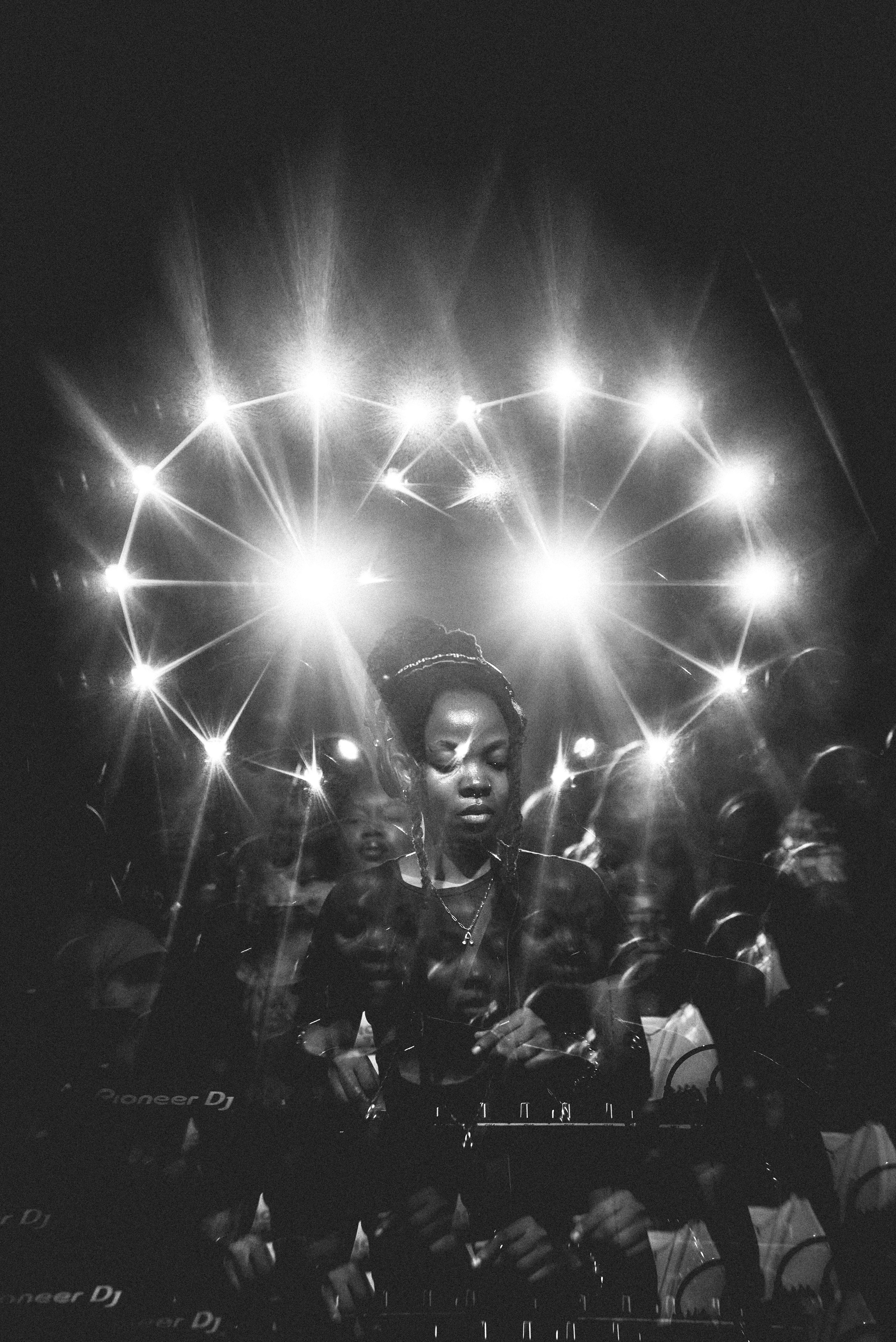
There were nights, she admits, when a camera flash was enough to undo her. She'd be mid-set, playing to a room that had no idea what was happening behind the decks, and something as small as a photographer trying to catch a shot of her while playing would pull her straight back to losing Chado. She wouldn't stop the set – she'd instead crouch quietly, eyes swollen, still mixing, still holding the room together and powering through it.