" transform="translate(2.266 2.266)" width="17.218780000000002px"/><path d="M 8.156 4.078 C 8.156 5.16 7.727 6.197 6.962 6.962 C 6.197 7.727 5.16 8.156 4.078 8.156 C 2.997 8.156 1.959 7.727 1.194 6.962 C 0.43 6.197 0 5.16 0 4.078 C 0 2.997 0.43 1.959 1.194 1.194 C 1.959 0.43 2.997 0 4.078 0 C 5.16 0 6.197 0.43 6.962 1.194 C 7.727 1.959 8.156 2.997 8.156 4.078 Z" fill="transparent" height="8.15622px" id="O9Ncbsd4H" stroke-dasharray="" stroke-linecap="butt" stroke-linejoin="miter" stroke-miterlimit="10" stroke-width="1.35938" stroke="rgb(31, 31, 31)" transform="translate(6.797 6.797)" width="8.15622px"/><path d="M 0.009 0 L 0 0" fill="transparent" height="1px" id="twDD_I79T" stroke-dasharray="" stroke-linecap="round" stroke-linejoin="round" stroke-width="1.8125" stroke="rgb(31, 31, 31)" transform="translate(15.857 5.891)" width="1px"/></svg>)
" transform="translate(2.719 2.719)" width="16.312450191802977px"/></svg>)

Written by Olawale Toriola
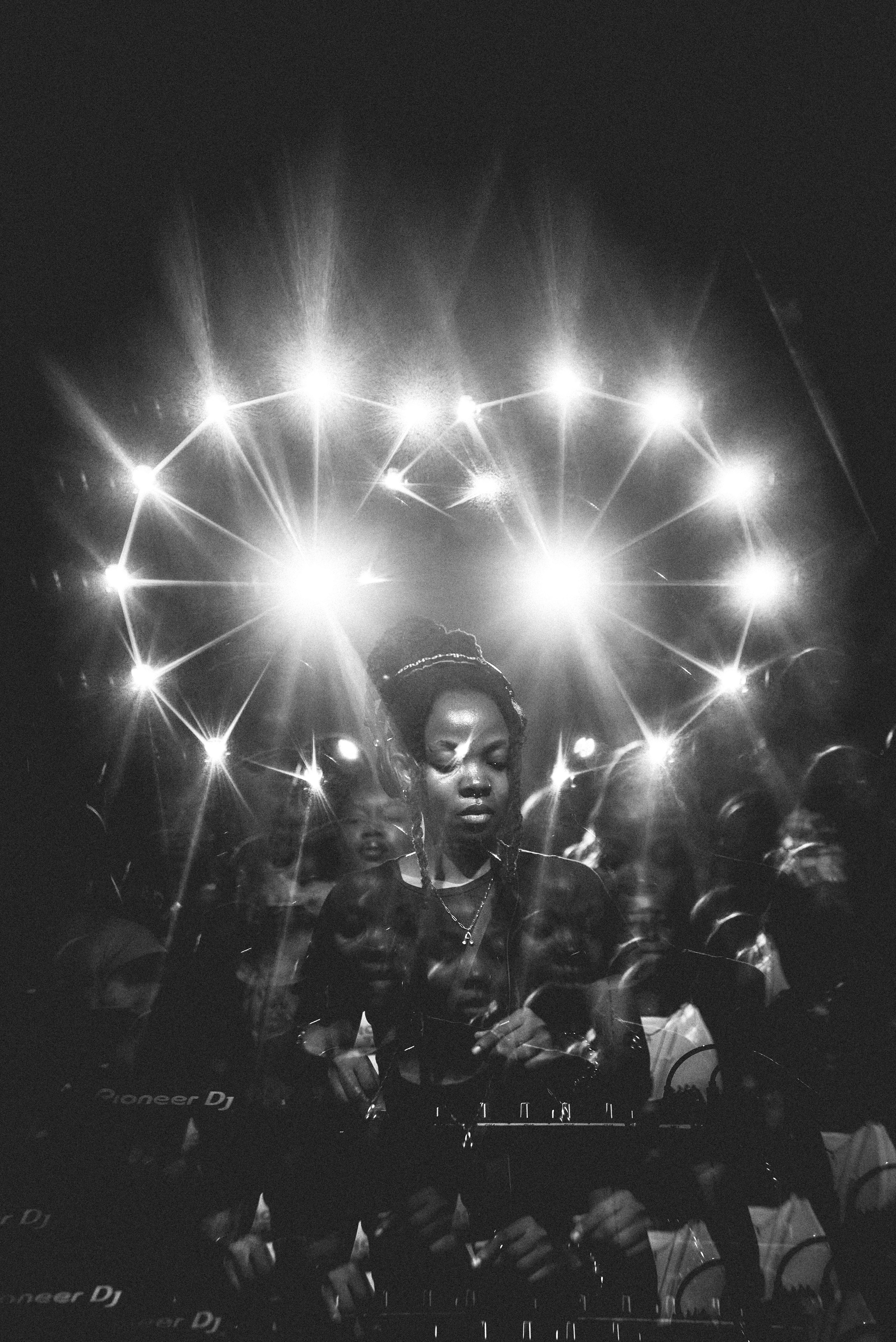
If you are remotely conversant with the electronic music scene that has been bubbling in Lagos and across Africa, there is a good chance that, by some stroke of luck or intentional design, you have come across the name Abiodun. There is an even greater chance that you have found yourself moving to the way he bends sound when he is behind the decks. But before finding himself behind the decks, Abiodun had already travelled a curious, winding road from law, tech and journalism to making lo-fi-adjacent records under the moniker Bio, and later as part of the duo Miles from Mars.
His appetite for curiosity has pushed him over the edge more times than we can count, and at every turn, he has found a new language through which to express himself. His latest discovery has positioned him right at the heart of the electronic music renaissance sweeping across Africa. In 2023, he started what would eventually become Ilé Ijó, although it initially went by the name Miliki. By 2024, Miliki had evolved into Ilé Ijó, a name that translates directly to “House of Dance.” What began as a relatively intimate experiment has since grown into something far more deliberate: a room for music that exists outside the centre of the mainstream, particularly the fast, abrasive and experimental sounds increasingly shaping underground club culture across Africa.

Over the past two years, Ilé Ijó has become less of an event and more of a laboratory for Abiodun’s curiosity. House music was only the beginning. The collective has since stretched into Drum & Bass, Singeli and other corners of electronic music, constantly testing the limits of what a Lagos dance floor can accommodate. To celebrate its second year anniversary, the collective announced Supercontinent in August, with portugal’s DJ HELVIFOX making his debut as headliner for a special Kuduro/Batida showcase in Lagos. Its Drum & Bass arm, Drum N Bass NG, emerged from an idea conceived by Marina Rd., a resident DJ at Ilé Ijó, and quickly became another avenue for the collective to build community around a sound that had previously occupied a relatively niche position in the city.
The music moves differently too, typically between 160 and 180 BPM, trading the slower hypnosis of house for something faster, more frantic and euphoric. Then there is Club Àlùjó, perhaps the clearest expression yet of Abiodun’s instinct to collide seemingly disparate worlds. In December 2025, the project won Boiler Room’s Broadcast Lab competition, earning a global platform for its radical reimagining of Fuji within a club context. The concept brings emerging live Fuji acts into conversation with DJs, building a space where the music can be heard differently without stripping it of its cultural DNA. But the experimentation does not stop with the music. Club Àlùjó is equally concerned with the world surrounding the sound—the visual language, the atmosphere, the clothing and the cultural references that make the experience feel distinctly Yoruba rather than simply another electronic music night. It is Abiodun doing what he seems to do instinctively: taking something familiar, placing it somewhere unexpected and asking what else it could become. And then there is ByUSBNetwork, another extension of the Ilé Ijó ecosystem dedicated to creating room for the next generation of electronic dance music DJs emerging from Lagos and other Nigerian cities. Rather than simply booking established names, the platform creates an entry point for artists still finding their footing, giving them access to audiences and stages they might otherwise struggle to reach.
This is perhaps the most interesting thing about Abiodun’s journey: curiosity rarely leaves him alone. It keeps producing another question, another experiment, another room to build.
At a time when Lagos’ electronic scene is expanding rapidly, Abiodun appears less interested in simply participating in its growth than in interrogating what it can become. Ilé Ijó, Drum N Bass NG, Club Àlùjó, ByUSBNetwork and Supercontinent may look like separate projects on paper, but together they reveal a much larger philosophy: build the room, invite the people, turn up the sound and see what happens when curiosity is given somewhere to live. For Abiodun, the founder and creative director behind Ilé Ijó, the original idea has not necessarily changed. If anything, it has become clearer. “The objective behind the brand is to create a room and just do things differently from what the Lagos market or the Nigerian market has been used to,” he explains to Black Noise Magazine.
Abiodun’s own immersion in the global electronic music scene has only reinforced that instinct. Travelling, playing and experiencing club cultures in places such as Uganda, Ghana, Ethiopia and Kenya has given him a wider perspective on where electronic music is moving and, perhaps more importantly, where Lagos can still go. For this reason, he sees a global shift towards faster, harder and more high-BPM forms of dance music. For Ilé Ijó, following that movement is not about chasing a trend. It is about remaining faithful to its original purpose: experimentation. And that purpose becomes increasingly important as the crowds grow, as far as he is concerned, scale cannot become the thing that dictates the music.
“As a founder, as a curator, you decide what your room looks like,” he says. “You basically decide how your room takes shape based on the kind of music that you introduce to them.”
That philosophy has allowed Ilé Ijó to maintain its rawness even as its audience expands. The music remains the filter. If the sound is not for you, then perhaps the room is not for you either. “What matters to me is the music that we're playing, are they being true to our original objective of going underground? If that is the case, if it's five people, that's good to go.”
It is this same philosophy that sits behind Supercontinent, Ilé Ijó’s latest offering—a dedicated platform for exploring underground electronic and club sounds from across Africa.

A Supercontinent
Supercontinent is not simply another Ilé Ijó party series. Abiodun describes it as a separate project—one designed to give the collective room to go deeper into the sounds emerging from different parts of the continent. Ilé Ijó itself has become deliberately fluid. In the sense that over the past two years, the platform has experimented with different formats and themes, using its parties as a space to test ideas. Supercontinent, however, has a more specific mission. “Supercontinent is just our project for putting people onto a specific underground club music or electronic dance music,” he says.
The idea is to create an umbrella under which different African sounds, cities and scenes can be explored. Singeli. Kuduro. Other sounds emerging from the Congo, South Africa, Ghana and elsewhere. Each new sound becomes an opportunity to introduce Lagos to another part of the continent. This motivation comes partly from what Abiodun sees as a gap in the local scene, that despite the growth of Nigeria’s electronic music community, he believes there remains a lack of familiarity with what is happening elsewhere. His experiences outside Nigeria have shown him just how expansive those possibilities are.
“I played a festival in Uganda last year,” he says. “Seeing people from across the world dancing to all kinds of music, I found that very inspiring.”
Ghana offered a similar perspective. The experimentation and openness to different sounds in other African scenes made him arrive at a simple question: what could happen if Lagos audiences were given greater access to those same possibilities. “How do we bring that same thing here?” he asks. “How do we begin to do those same things here in a scene where everyone is sort of feeling fatigued of the usual stuff?”
For Supercontinent, the answer is simple: introduce something new.
Supercontinent as movement exists to counter the growing narrative around African music: find a sound locally, package it, and export it to the rest of the world. For Abiodun, Africa does not always need to look westward to validate the sounds emerging from its own communities. There is already enough happening across the continent to build a meaningful exchange between African scenes themselves. “This electronic dance music scene has to be bigger than us,”. That means Lagos becoming a destination for sounds from other parts of Africa, while Nigerian artists are simultaneously given opportunities to move in the opposite direction.
The ambition is not simply to import foreign DJs for individual nights. It is to build relationships between communities. If a new sound emerges from another African city, Supercontinent wants to understand it, contextualise it and bring it into conversation with Lagos. And if someone in Calabar, Benue or anywhere else in Nigeria is making something distinctive, the same logic applies. “It goes beyond just bringing in people from outside of Nigeria, where is the sound? Where is the next best sound that we like coming from?”
That question is central to the project.
Why Kuduro?
It is fitting that Supercontinent’s first chapter turns to Kuduro. Born in Angola and now deeply embedded in global club culture, Kuduro represents exactly the kind of journey that interests Abiodun: a sound originating in Africa, travelling beyond its point of origin and developing a life across different communities. “Outside of Nigeria, in the electronic global club music scene, I would say Kuduro is one of those very far-travelled sounds that originated from Africa,” he says. Its international reach makes it a particularly useful entry point for Supercontinent. But there is another reason for its relevance to Nigeria: Abiodun believes versions of Kuduro have already appeared in Nigerian popular music without necessarily being identified as such. He points to records such as Cabo Snoop’s “Pracatátumba” and “Windeck” as examples of songs that demonstrate how these rhythmic ideas have already travelled into Nigerian listening culture and the problem, in his view, is partly one of language and context. “We just sort of overlooked it,”
Supercontinent therefore becomes an exercise in naming, contextualising and rediscovering. It is not simply about introducing Lagos to completely foreign sounds. Sometimes it is about showing audiences connections that were already there.

Dig, then dig deeper.
So you might be wondering, what determines which sound gets the Supercontinent treatment? For Abiodun, the first question is almost deliberately uncomplicated, so simple that he described it as anticlimatic:
“Is the music good?”