" transform="translate(2.266 2.266)" width="17.218780000000002px"/><path d="M 8.156 4.078 C 8.156 5.16 7.727 6.197 6.962 6.962 C 6.197 7.727 5.16 8.156 4.078 8.156 C 2.997 8.156 1.959 7.727 1.194 6.962 C 0.43 6.197 0 5.16 0 4.078 C 0 2.997 0.43 1.959 1.194 1.194 C 1.959 0.43 2.997 0 4.078 0 C 5.16 0 6.197 0.43 6.962 1.194 C 7.727 1.959 8.156 2.997 8.156 4.078 Z" fill="transparent" height="8.15622px" id="O9Ncbsd4H" stroke-dasharray="" stroke-linecap="butt" stroke-linejoin="miter" stroke-miterlimit="10" stroke-width="1.35938" stroke="rgb(31, 31, 31)" transform="translate(6.797 6.797)" width="8.15622px"/><path d="M 0.009 0 L 0 0" fill="transparent" height="1px" id="twDD_I79T" stroke-dasharray="" stroke-linecap="round" stroke-linejoin="round" stroke-width="1.8125" stroke="rgb(31, 31, 31)" transform="translate(15.857 5.891)" width="1px"/></svg>)
" transform="translate(2.719 2.719)" width="16.312450191802977px"/></svg>)

Written by Temple Egemasi
Group Therapy’s third anniversary edition delivered exactly what the collective’s faithful have come to expect on the dance floor: a masterclass in sonic architecture. Inside the room, the curation was airtight. From the hypnotic, rolling basslines of Afrohouse to the deliberate, heavy-footed cadence of 3-Step and the frenetic pulse of Mara, the transitions were seamless. The energy was electric, anchored by that distinct communal synchronicity that makes a Group Therapy floor feel less like a party and more like a sanctuary. By all sonic metrics, it was another one for the archives. But outside, away from the DJ booth, the night was also telling a second, less palatable story; one that had nothing to do with the lineup, and everything to do with the city holding it.
Hobson’s Choice?
Strip away the branding, the curation, the reputational weight any individual promoter carries, and the math in Lagos stays the same: there are, by most working estimates in the scene, a handful of venues in the entire city – arguably as few as four – actually built to hold a crowd of the size the electronic music event now regularly draws.
Everyone is booking the same rooms, on the same weekends, against the same population growth curve. When demand for a night outpaces the room's physical capacity, the failure points are predictable and not particular to any one organiser.
Group Therapy's usual rotation of dependable indoor venues leans on a short list, Livespot Centre and Landmark Centre being chief among them. These are rooms the team has returned to precisely because they're purpose-built to actually hold a GT-sized crowd without falling apart at the seams. Neither was available for this edition. Livespot had offloaded a chunk of its property to Bokku Mart, shrinking the footprint the venue could offer. Landmark was already booked out. Because no other indoor space in the city could realistically absorb a crowd this size, the situation left the organizers choosing not between a preferred venue and a backup, but between one indoor option and no event at all.
That's the part that tends to get lost when one bad night happens to a good series. The venue math in Lagos doesn't bend for anyone’s good intentions.
And who are you?
In the days after, timelines filled up with two very different complaints that point to the same root problem. On one side, guests who'd clearly bought their tickets in advance and showed up with no real sense of what kind of room they were walking into: people who hadn't absorbed the culture, the etiquette, or the unspoken rules of a GT floor. On the other side, people with no ticket at all who somehow found their way to the ticketing boothregardless. Put those two side by side, and the dilemma comes into focus: pre-sale ticketing gets people in the door without ever screening for whether they understand the space they're entering, while even that system still isn't airtight enough to keep out the people it was supposed to filter for in the first place.
It's the kind of problem that makes a door-only ticketing model look tempting. At the recent Black Noise SGNL Summit, Isabelle Ho Kang Yu spoke to one method international promoters have leaned on to keep undesirable elements out of a venue: selling tickets exclusively at the door, using the friction of in-person payment as a filter. On paper, it would solve exactly half of what showed up in those timelines: no ticket, no entry, full stop.
It's a policy that falls apart in Lagos, though, and not just because of the half of the problem it was never built to solve. A door-only model might address the gatecrashing, but it does nothing for the other complaint – knowing your audience showed up because they paid says nothing about whether they showed up ready to behave like they belong there. And even on its own terms, because it is a model that works in markets with fast, reliable point-of-sale infrastructure that takes seconds, this model runs into a second wall: local payment rails, internet and infrastructure. The local payment rails are slower and less consistent than what a door-only system assumes, which means it doesn't filter a crowd so much as relocate the bottleneck to the one place an organizer can least afford it – the entrance, on the night, with a line building behind every transaction. Add a venue already near or past its comfortable capacity, and a slow door doesn't just inconvenience people. It creates the exact kind of crush and crowd agitation that lets bad actors work a line unnoticed – including, it turns out, the ones who make it past the door without a ticket at all. So, back to square one.
Organizers here are stuck choosing between a ticketing model that curbs gatecrashing elsewhere and a door process that would strand their own paying guests in a queue for over an hour, and no promoter serious about the experience they're selling is willing to do that to the people who did everything right. Neither option, on its own, solves for a crowd that includes both the confused and the uninvited.

Dry-Hired, Under-Equipped, and more palaver.
There's a second, quieter piece of this, one that Tomisin Akinwunmi has pointed to in conversations about how these events actually get built. During the SGNL Summit knowledge-sharing session, she put it simply: venues in Lagos are overwhelmingly dry-hired. An organizer isn't renting a turnkey space with security infrastructure, trained crowd management, or parking allocation baked in; they're renting four walls and a patch of land, then building every layer of the experience from scratch, event after event, with a fraction of the lead time and budget that a purpose-built venue would take off their plate.
To properly quantify this logistical tax, Tomisin draws a sharp contrast between executing a show at home versus abroad. For every Group Therapy edition in Lagos, paying the venue fee merely buys the right to begin constructing the club. The team must conduct a physical sweep a full day before the event just to gauge the structural deficits they need to cover. For a rave slated to start at 9 PM, the physical build begins at 10 AM (the previous day!) – an exhaustive, almost 48-hour sprint to install everything from sound systems to barricades just to make an empty shell functional. Compare that to the collective's London run, or even Nairobi. Because the city possesses infrastructure actually designed for the culture, Tomisin had the luxury of arriving at E1 at 6 PM for an 8 PM show. The heavy lifting was absent; the team simply walked into a purpose-built space, powered up the venue’s pre-installed sound system, and started the night.
The venue for this edition made that gap unusually visible. Set against Livespot and Landmark, the venues GT would ordinarily be working with, the difference in what the space could actually offer was stark. The car park was considerably smaller. The compound didn't have the room to host vendors outdoors the way the other two venues do, which meant an entire layer of the usual GT experience simply couldn't exist this time. The main hall on its own couldn't absorb the crowd while being properly spaced, forcing the organizers to innovate their way around the issue by bringing the ground-floor hall into play as a second room to fit everyone and their sonic palette.
Then geography made a bad situation worse. Queens Park Event Centre sits close to the newly constructed Coastal Highway, and that proximity set off a chain reaction none of the standard dry-hire fixes could have anticipated. GT attendees trying to reach the venue were funnelled into the same access point as regular road users on the highway, so the two streams of traffic collided before anyone even got near the gate. Once cars did make it through, the undersized parking lot had nowhere to absorb them, and that backup fed straight into the expressway, turning a parking shortfall into a full gridlock on a major road. Layered on top of all of it: construction of the Coastal Highway had displaced many people from the surrounding area who never fully relocated, and on the night, some of that displaced population turned opportunistic – confronting and harassing partygoers who'd abandoned their cars in the gridlock and were walking the rest of the way in. What read, from inside the event, as a security failure was in fact the tail end of a domino effect from the fallout of an unrelated infrastructure project the organizers had no hand in and no way to plan around.
The Outdoor Workaround
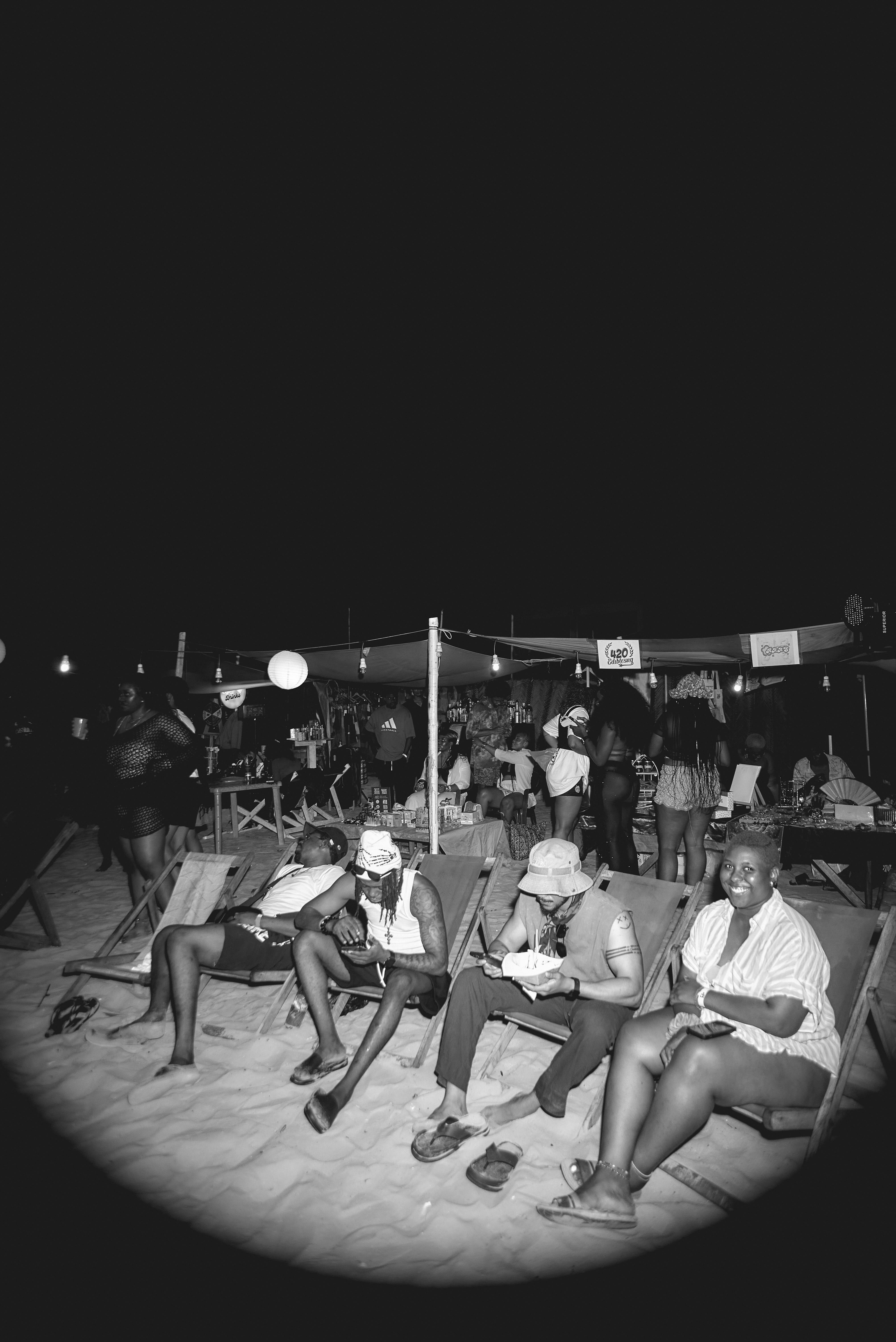
As indoor options continue to shrink, promoters are increasingly looking to the sand and the open air.
For Dayo, co-founder of Group Collective, trading concrete for sand solves several critical infrastructure problems at once, most notably, density and flow.
"Capacity and crowd density — we can accommodate a larger crowd without creating the same level of compression," Dayo explains.
Beyond just providing physical breathing room, which, as Dayo points out, means "we're not dependent on AC" failing mid-set, the open air offers vital layout flexibility. In a worst-case scenario, organizers aren't battling a single-door bottleneck; they have the spatial freedom to allow a crowd to safely disperse in an emergency.
Dayo recognizes though that, while the beach offers a spatial reprieve, it is ultimately a workaround rather than a systemic cure. Trading concrete for sand solves the density problem, but it introduces a volatile new matrix of dry-hire challenges. Organizers must now secure perimeters in open terrain, haul in off-grid power, and construct sanitation, lighting, and emergency response systems entirely from scratch. The open air relieves the physical compression of the venue, but the grueling logistical tax of building temporary infrastructure remains squarely on the promoter’s shoulders.